Showing posts with label Foot. Show all posts

Friday, June 30, 2017

Yoga for Foot Pain


by Baxter
Study of Hands and Feet for the Golden Age by Ingres
As I was preparing for an upcoming workshop on Yoga for Healthy Feet at Mountain Yoga in Oakland, California, I happened to review our recent communications from you, our readers (thanks for all of these questions, by the way, and keep them coming!), and came across this timely inquiry:

I am a 67-year-old female in good physical condition. About 10 years ago, I slipped down a steep hill and came to a stop half way down the hill, using my foot to stop. I immediately had severe pain in the arch of my foot to which I applied ice. Every since then, I have had pain in the arch of my foot, to varying degrees. I now have that pain wrapping around from the arch to the top of my foot and pain that wraps around my ankle. Even the bone on the medial side of my foot, above the arch, becomes sore at times. I frequently wake up in the middle of the night with arch pain. When I walk fast at all, I get shooting pain in my arch. I have been to the orthopedic doctor and they have injected steroids into the tendon sheath in the bottom of my foot and also by the ankle. These injections have helped for a short time. I don’t want any more steroids. Are there any yoga exercises that I could be doing to strengthen this area and to decrease the inflammation that is there? Any suggestions would be very much appreciated.

I’d like to start by acknowledging how challenging traumatic injuries can be to our bodies, and how they sometimes don’t easily heal and allow us to feel like our old selves again, at least not on the timetable we would prefer! Our reader’s situation appears complicated in the sense that the pain she experiences moves around, is aggravated by certain activities, has been around a long time, and even wakes her up at night. And despite seeing an orthopedic specialist and getting some steroid injections to decrease inflammation in the tissues of her foot, her pain persists. Although I cannot make specific recommendations for this person without a more thorough history and physical, I can provide some general recommendations on approaching foot pain and working toward stronger and more supple feet and greater pain-free movement.

Non-Weight Bearing Mobilization

It turns out the feet are quite complex parts of the body. There are 52 bones in the feet, and each foot has approximately 33 joints, each of which can move in multiple directions. The possible number of distortions of the foot is a huge number, something on the order of 8x10 to the 36th power. In contrast to the foot’s huge variety of possible shapes and movements, we usually wake up, are in bare feet for just a few minutes in the morning and then jam our feet into shoes all day, which protect the feet for sure, but limit movement dramatically. So the first wonderful thing about practicing yoga is that you liberate your feet from shoes for however long your home practice is each day. In the context of painful feet, it may be a great starting place to do yoga practices that are non-weight bearing, since things like brisk walking, as in our reader’s case, might be influencing the persistence of pain.

A good place to start would be with any “warm-up” practices that involve lying on your back or belly and moving your limbs and feet around. An example would be Legs up the Wall pose (Viparita Karani), in which you could add in movements of your feet and ankles to promote mobility of the joints and soft tissues of your feet. Other examples of poses where there is no or very little pressure on your feet include Thread the Needle pose, Locust pose (Salabasana), and Reclining Twist pose (Jathara Parivartanasana). In all these poses, you can deliberately choose how you want to position your feet and ankles—whether you want to spread or curl your toes or vary other foot movements and positions—to bring greater awareness to how your feet are doing moment to moment. Once you are comfortable in these poses and your foot pain doesn’t flare, you are ready to move on.
Locust with One Leg Up
Mild Weight-Bearing Poses


There are several basic yoga poses that begin to require more of your feet in terms of dealing with forces to the soles, the tops, and the edges of your feet. As you introduce this new group of poses, you will again be monitoring how your feet respond during the practice, as well as after the practice, such as overnight. Some of my initial choices include:
  1. Reclined Leg Stretch pose (Supta Padangustasana)
  2. Bridge Pose (Setubanda Sarvangasana)
  3. Seated Crossed-Legs Pose (Sukasana)
  4. Cobblers Pose (Baddha Konasana)
With Reclined Leg Stretch, you are still not bearing weight but you are bringing pressure onto the sole of your foot with the strap. You can vary the location of the strap; I like the heel pad, the mid-foot, or the ball of the foot. And you can vary the intensity of the pull of the strap to gauge how much your foot can handle.
Reclined Leg Stretch Pose
With Bridge Pose, you are beginning to bear weight on your feet, but not your entire body weight, so this pose provides is good way to test the waters to see what your feet are ready to handle. The other seated poses put a bit of pressure on different parts of your feet and can help reveal areas of ongoing tenderness that might need a slower approach towards full function.

Full Weight-Bearing Poses

When you are feeling ready to stand up and see how your feet handle more challenging situations, you can begin to explore the basic two-legged standing poses. Mountain pose and all of its variations—arms overhead, side bending, and so on—are the starting place and a good home base to return to for this group of poses. 
Arms Overhead Pose
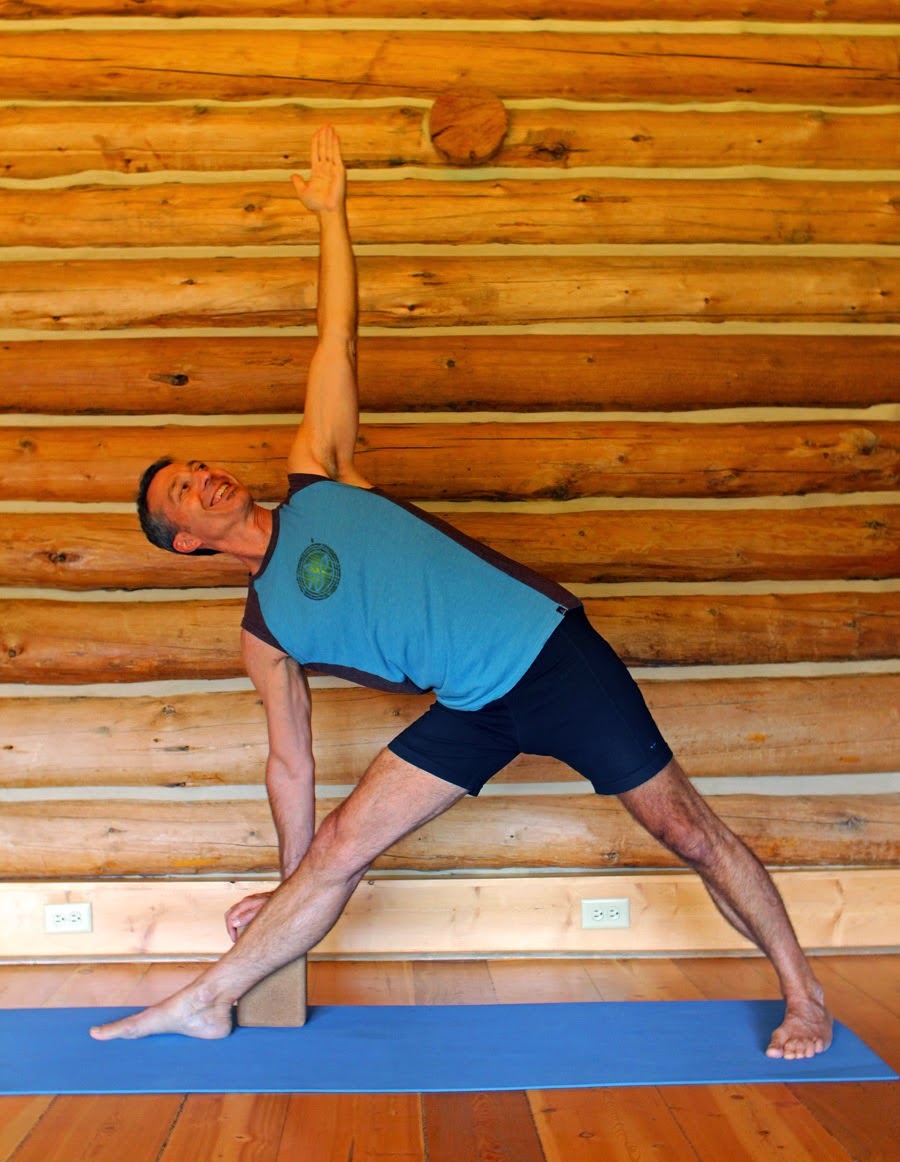
From there, move on to the classic two-legged standing poses, such as Triangle pose (Trikonasana), Warrior 1 and 2 (Virabrdrasana 1 and 2), Extended Side Angle pose (Utthita Parsvakonasana), Pyramid pose (Parsvottansanas), and Widespread Standing Forward Bend (Prasarita Padottanasana). Each of these poses will bring slightly different challenges and forces to your feet and ankles. You might add them gradually over time and assess how each one affects the feet.
Triangle Pose
Once poses on two feet are becoming easier, add more challenge by working on one-legged poses, such as Tree pose (Vrksasana), Half Moon pose (Arda Chandrasana), Eagle pose (Garudasana), Warrior 3 (Virabradrasana 3), and Dancer pose (Natarajasana). Be willing to go more slowly with these pose, however, as they will focus more force and pressure onto your feet and ankles, and may require more time and attention to get better at. 
Warrior 3 Pose
Dynamic Movements

In real life, we are moving around on our feet quite a bit, walking, occasionally squatting, and periodically dancing, cycling, or running. You can ready and train your feet for these variable movements by practicing dynamic yoga sequences. The most obvious choices are Sun Salutations and Moon Salutations, but I suggest that you can also allow yourself some creative license to invent your own dynamic movement using yoga poses. Keep a playful, yet focused attention as you move in and out of various yoga poses with clear awareness of your feet. 

See Agility Practice and  Want to Improve Your Balance? Take Off Your Shoes! for more ideas.


Finally…

Hopefully these suggestions can assist in the healing process from a variety of painful foot issues. There are certainly many other non-yoga practices and therapies we cannot cover here, but you have a starting place with yoga to begin your healing journey.

Subscribe to Yoga for Healthy Aging by Email ° Follow Yoga for Healthy Aging on Facebook ° Join this site with Google Friend Connect

Monday, June 5, 2017

Factors To Consider When Choosing The Right Austin Foot Doctor


By Katrina Wheeler


Foot injuries can sometimes be very severe. When you are injured on your feet, it is advisable to look for a specialist in foot injuries. These specialists are also referred to as podiatrists. You should go for a podiatrist who has specialized in the kind of injury you are suffering from. For the most qualified Austin foot doctor patients can check locally or online.

A lot of things need to be considered when choosing this kind of a specialist. Start by seeking referral from your primary health care provider. Take your time to talk to him well to see if he is going to recommend you a good specialist. Getting a referral from your primary health care provider can give you peace of mind simply because he cannot betray you in any way.

You can also get referrals from your friends or relatives. People who had problems like yours in the past can also recommend you those podiatrists they used. Seek help from people whom you can trust. Consider talking to different people in order to get different suggestions. If you have no one to recommend you a specialist, look at your local podiatry website. Here you can find several names of experienced podiatrists who practice in your area.

The Internet is also another resourceful place where these professionals can be found. There are many podiatrists with websites out there. You need to explore their websites in search of information. Consider checking for information such as experienced, qualification, and credentials. You also need to check their review pages in order to see how previous patients are saying about their services.

Once you have researched several doctors, you need now to contact them for an interview. You must have a list of all podiatrists that you have come across during your search. Call them via the telephone and schedule consultations. Create a list of questions that you are going to ask them during the interview. Make sure that you inquire about everything pertaining to your treatment.

Ask about the treatment procedures they use. Let the doctor tell you all the possible treatment procedures in order to choose one that you feel comfortable with. You may also want to know how long the treatment is likely to take. The length of time the treatment is likely to take will depend on the complication of your problem.

Always go for an experienced practitioner. You want someone who has been in this field for over 10 years. This is because such a practitioner is well-versed with all the effective treatment procedures used. Also, such a doctor must have dealt with different patients who had problems similar to the one you have. Stay away from doctors who have been around for less than 5 years simply because they lack the necessary experience.

Your chosen practitioner must be qualified. He must be trained to treat the specific problem that you are suffering from. Consider asking for certificates in order to ascertain their qualifications. Check to see that the certificates are genuine. When searching for the right Austin foot doctor patients can look locally or online.


About the Author:


Thursday, March 23, 2017

Relieve Pain With Custom Foot Orthotics Santa Monica


By Gilbert Holmes


Improper orthotics may be the cause for lower back, joint problems including hip and knee ache must be improved mechanically for balance. When stability is affected it makes normal walking and similar actions increasingly difficult and requires correction to alleviate body limitations. For Santa Monica Custom Foot Orthotics communities can benefit from prosthesis designed to improve abnormal function and form.

Orthotics is a procedure that involves alignment of feet and joints to prevent poor balance and an inability to walk or move without pain. The creation of a foot prosthesis can provide maximum support including relief from painful symptoms that result from compromised operation including injuries, flat feet, high arch development and heel spurs. A professional will evaluate overall alignment to determine corrective efforts for health and wellness.

Arch supports and supportive inserts for shoes can be found at a store, but most of these products will not produce long term results for relief or correction of foot problems. A professional examination includes a look at overall gait and stability to detect the underlying cause for ongoing symptoms. Once a thorough evaluation has been completed, an individualized wellness program can prove most beneficial.

Therapy suitable for individual needs can assist in relieving the problems of flat feet, structural problems and incorrect alignment. Including a prosthetic will assist in supporting stability without having to undergo surgical procedure for correction. The purpose for non-invasive care is to provide the limbs and feet with optimum support to improve the ability to walk and move without dysfunction.

A large number of sports persons and those who work on their feet through the day report complications in movement and general foot pain. The design of customized orthotics can provide a high degree of support for feet and correct the abnormalities that many people suffer from. Individuals who wish to move without the experience of restrictions can aid in providing a sense of relief and freedom of flexibility.

A tailored health approach can be created to suit specific patient needs with durable inner soles and support to improve comfort levels and operation. The prosthesis is important to restore balanced operation and reduce the severity of symptoms that are experienced on a regular basis. To improve daily movement requires the correction of structures and improvements in the ability to move in a normal manner.

A professional approach includes consultation with patients to complete an evaluation of function and the structural condition of each foot. For those debilitated by leg, knee or hip pain, it may indicate that the alignment of feet has been compromised and requires correction to improve the ability to move on a regular basis. A thorough professional evaluation of operation must be completed to provide relief from dysfunction on a regular basis.

The assistance provided by a certified practitioner can aid in determining effective methods to correct abnormalities that are related to the feet. Using customized orthotics can improve daily movement and offer optimum levels of support for the correct foot form. A complete evaluation of movement is required to enhance health and the ability to reach a state of fuller functionality.


About the Author:


Thursday, February 2, 2017

How To Relieve Foot Pain By Using Insoles For Flat Feet


By Rosella Campbell


Foot problems are common and many people suffer from chronic pain and discomfort. Most patients that seek help from podiatrists are women and these experts agree that the most common cause for these problems are the wearing of high heels or the wrong type of shoe. Fallen arches are also common. People suffering from this problem have very low or no arches at all. By wearing insoles for flat feet the discomfort can often be negated.

Fallen arches can be the cause of a range of symptoms. Some sufferers experience constant pain but most sufferers experience at least some pain when they are forced to stand for extended periods of time. Standing for long periods can also cause intense pain in the lower back region. The swelling of the inside of the ankles is also a common complaint. The condition makes it difficult to for sufferers to stand on their toes.

There is no cure for this condition. Podiatrists routinely recommend sufferers to try special soles that are designed to support the arches. The vast majority of sufferers benefit from these soles. They can be bought over the counter and in special cases a podiatrist can even order a custom made set if, for some reason, ready made products simply do not provide relief.

Even if the condition cannot be cured a lot can be done to lessen the pain and discomfort. Sufferers are encouraged to perform a variety of exercises that are all designed to strengthen the ligaments and muscles of the foot. This includes running on the toes as long as possible and stretching the toes apart from each other in several repetitions. Sufferers are also advised to walk barefoot as often as possible.

There have been rare cases where surgery has been tried but even highly experienced surgeons will only attempt it as a last resort. Reputable podiatrists shun this procedure and say that it is both too risky and dangerous. After making an incision on the side of the foot a plastic insert is put in the bones of the ankle. However, if this fails the patient will experience lifelong pain and discomfort.

Dropped arches have many causes. People suffering from obesity and arthritis are especially at risk. As one grows older, the tendons running along the ankles often weaken and this can also cause the arches to drop. Physical injuries to the foot can also cause these tendons to become inflamed and if it is not treated, the arches may drop. In many cases, however, people with dropped arches were born with the condition.

There are a number of things people can do to prevent the arches from dropping. When exercising, it is very important to wear the correct shoes and to choose shoes that will distribute the weight. High heels one of the biggest causes and women should wear them for short periods only, if at all. Another important precaution is to lose weight.

Inserts that support the arches is one of the easiest and most cost effective ways in which to relieve the pain and discomfort common to those with dropped arches. They should even be worn by those with healthy foot arches as a preventive measure. Exercise also helps and it is vital to wear shoes that fit properly.


About the Author:


Tuesday, October 25, 2016

How To Reach Foot Pain Relief Accelerated By Acupuncture In Cambridge ON


By Bob Albert Lewis


Podiatry problems can be caused by structural problems and conditions that affect the joints, ligaments, bones, and muscles. Most people who suffer from feet trouble report injuries, inflammation, and swelling that restricts movement and causes chronic pain. With natural approaches adopted by a Cambridge ON chiropractor and acupuncture therapist offer natural remedies and supportive services for improved function.

All individuals can become the victim of foot pain during some stage in their lives. The foot consists of 38 bones, nerves and soft tissues that are highly susceptible to strain and damage with daily function. Disorders can be attributed to an injury, poor footwear or genetic conditions that become worse over a period of time.

The shoes that are too tight can cause bunion formation where bones push outwards from the side of the foot. A lack of sufficient support in the soles can impact the normal function of the arch and cause high levels of discomfort. Heelspurs occur when the heel bone is damaged while many athletes report stiffness and strain because of an inability to engage in warm up exercises.

Acupuncture is a procedure with a natural basis that aims to tend to painful symptoms in the feet. The different pressure points must be stimulated with the delicate placement of needles to increase overall circulation. Such measures can reduce the amount of prescription medication used by individuals to achieve relief from dysfunction.

Enhancing overall blood circulation aids in moving nutrients and oxygen to the affected cells. Where the tissues are able to recover, it can alleviate distress and limitations in movement. Such measures should be implemented by a professional therapist to support flexible and pain free foot operation.

Intervention is developed to manage physical distress and to improve foot function. Natural methods can alleviate restrictions and prevent against an inability to achieve healthy operation. Acupuncture can be applied to heal the condition of the feet and protect from deterioration in general mobility.


About the Author: