Showing posts with label Syndrome. Show all posts

Monday, April 10, 2017

Thoracic Outlet Syndrome and Yoga


by Baxter

Thoracic Outlet Syndrome (TOS) arises most commonly in people who have been in traumatic accidents, typically in car accidents, or who do repetitive jobs, such as computer work at a non-ergonomic workstation, so that is potentially a lot of people. In addition to the two causes mentioned already, there are other less common causes of Thoracic Outlet Syndrome, like the presence of an extra small rib that can compress nerves and blood vessels near the lower side of the neck. Regardless of the underlying cause, folks who develop Thoracic Outlet Syndrome often complain of a host of symptoms, which can include, but are not limited to, numbness and pain in the affected side of the neck, that is, in the arm, front chest and neck. There can also be weakness in that arm or hand. Symptoms often come and go, and in some situations can be positional in nature, only arising when the affected side arm is lifted and held overhead for a little while. 

What’s happening under the skin, so to speak, is that any of a number of structures could be getting compressed that should not be. More specifically, the cervical nerves that come out of your spine and come together to form the brachial plexus, (a kind of super highway interchange of different nerves from the cervical spine before heading down into the arm) can be pushed on by muscles and/or bones and lead to the symptoms described above. The same fate can befall the subclavian artery, the large blood vessel from the heart that feeds the arms, as it moves through the area of the side neck, under the collar bone, and out into the upper arm. 

A commonly cited aggravator of this condition is poor posture, which we have mentioned in many other contexts as contributing to other body pain conditions, and for which yoga is such a great antidote. In fact, most people diagnosed with Thoracic Outlet Syndrome will first be referred to physical therapy for postural re-alignment and stretches to open up the area of the neck and upper chest in order to create more space around the brachial plexus and arteries and veins to lessen or eliminate the symptoms associated with the condition. One muscle group that is often implicated in compressing the nerves and blood vessels is the scalenes, specifically the anterior and medial bodies of this three-muscle trio.
Muscles of the Neck
It would be worth your while to review an anatomy book if you are interested in understanding these muscles, which movements they normally create, and how one might stretch them to relieve tension on our delicate nerves and arteries.

Yoga could be a great adjunct to this healing process, since many of our sequences and poses address this area of the body nicely. Even simple warm up exercises like shoulder rolls, where you bring your shoulders forward, then up, then back and down, can start to improve this area immensely. I start class with this kind of attention to the upper chest quite often. Basic attention to Mountain pose and supported reclining backbends would be good starting places as well. And there are a few postures that directly affect the scalenes, such as the head positions in Bharadvajrasana seated twist in which you rotate and then side-bend the neck.

Conversely, since folks with Thoracic Outlet Syndrome often get symptoms when their arms are held overhead, some caution must be used when doing yoga poses with the arms ups, like Warrior I pose, for instance, especially if you intend to hold the pose for a while. I would not be surprised that a few people out there may have become aware of their positional symptoms after starting yoga due to the demands of the poses on the arms. (Yoga would not “cause” Thoracic Outlet Syndrome, but could alert you to its presence in such positions as Mountain pose with arms overhead, Urdhva Hastasana.) If such postures do bring on pain or numbness, it might be more prudent to experiment with dynamic versions of such poses, moving the arms up and down with the breath to see if the dynamic action precipitates symptoms. If not, you could continue to practice this way or even add in short holds as long as no symptoms arise. 

By moving and liberating held tension in this area, ultimately you may be able to relieve the compression that is underlying the Thoracic Outlet Syndrome. In fact, most patients with this diagnosis find some improvement with modalities like physical therapy and, I suspect, yoga as well, and very few have to resort to surgical intervention to find relief. 

Subscribe to Yoga for Healthy Aging by Email ° Follow Yoga for Healthy Aging on Facebook ° Join this site with Google Friend Connect

Thursday, February 23, 2017

What is Carpal Tunnel Syndrome


Carpal tunnel syndrome occurs when the median nerve, which runs from the forearm into the hand, becomes pressed or squeezed at the wrist. The median nerve controls sensations to the palm side of the thumb and fingers (although not the little finger), as well as impulses to some small muscles in the hand that allow the fingers and thumb to move. The carpal tunnel - a narrow, rigid passageway of ligament and bones at the base of the hand - houses the median nerve and tendons. Sometimes, thickening from irritated tendons or other swelling narrows the tunnel and causes the median nerve to be compressed. The result may be pain, weakness, or numbness in the hand and wrist, radiating up the arm. Although painful sensations may indicate other conditions, carpal tunnel syndrome is the most common and widely known of the entrapment neuropathies in which the body's peripheral nerves are compressed or traumatized.

What are the symptoms of carpal tunnel syndrome ?
Symptoms usually start gradually, with frequent burning, tingling, or itching numbness in the palm of the hand and the fingers, especially the thumb and the index and middle fingers. Some carpal tunnel sufferers say their fingers feel useless and swollen, even though little or no swelling is apparent. The symptoms often first appear in one or both hands during the night, since many people sleep with flexed wrists. A person with carpal tunnel syndrome may wake up feeling the need to "shake out" the hand or wrist. As symptoms worsen, people might feel tingling during the day. Decreased grip strength may make it difficult to form a fist, grasp small objects, or perform other manual tasks. In chronic and/or untreated cases, the muscles at the base of the thumb may waste away. Some people are unable to tell between hot and cold by touch.

What are the causes of carpal tunnel syndrome ?
Carpal tunnel syndrome is often the result of a combination of factors that increase pressure on the median nerve and tendons in the carpal tunnel, rather than a problem with the nerve itself. Most likely the disorder is due to a congenital predisposition - the carpal tunnel is simply smaller in some people than in others. Other contributing factors include trauma or injury to the wrist that cause swelling, such as sprain or fracture; overactivity of the pituitary gland; hypothyroidism; rheumatoid arthritis; mechanical problems in the wrist joint; work stress; repeated use of vibrating hand tools; fluid retention during pregnancy or menopause; or the development of a cyst or tumor in the canal. In some cases no cause can be identified.


There is little clinical data to prove whether repetitive and forceful movements of the hand and wrist during work or leisure activities can cause carpal tunnel syndrome. Repeated motions performed in the course of normal work or other daily activities can result in repetitive motion disorders such as bursitis and tendonitis. Writer's cramp - a condition in which a lack of fine motor skill coordination and ache and pressure in the fingers, wrist, or forearm is brought on by repetitive activity - is not a symptom of carpal tunnel syndrome.

Who is at risk of developing carpal tunnel syndrome ?
Women are three times more likely than men to develop carpal tunnel syndrome, perhaps because the carpal tunnel itself may be smaller in women than in men. The dominant hand is usually affected first and produces the most severe pain. Persons with diabetes or other metabolic disorders that directly affect the body's nerves and make them more susceptible to compression are also at high risk. Carpal tunnel syndrome usually occurs only in adults.

The risk of developing carpal tunnel syndrome is not confined to people in a single industry or job, but is especially common in those performing assembly line work - manufacturing, sewing, finishing, cleaning, and meat, poultry, or fish packing. In fact, carpal tunnel syndrome is three times more common among assemblers than among data-entry personnel. A 2001 study by the Mayo Clinic found heavy computer use (up to 7 hours a day) did not increase a person's risk of developing carpal tunnel syndrome.

During 1998, an estimated three of every 10,000 workers lost time from work because of carpal tunnel syndrome. Half of these workers missed more than 10 days of work. The average lifetime cost of carpal tunnel syndrome, including medical bills and lost time from work, is estimated to be about $30,000 for each injured worker.


How is carpal tunnel syndrome diagnosed ?
Early diagnosis and treatment are important to avoid permanent damage to the median nerve. A physical examination of the hands, arms, shoulders, and neck can help determine if the patient's complaints are related to daily activities or to an underlying disorder, and can rule out other painful conditions that mimic carpal tunnel syndrome. The wrist is examined for tenderness, swelling, warmth, and discoloration. Each finger should be tested for sensation, and the muscles at the base of the hand should be examined for strength and signs of atrophy. Routine laboratory tests and X-rays can reveal diabetes, arthritis, and fractures.

Physicians can use specific tests to try to produce the symptoms of carpal tunnel syndrome. In the Tinel test, the doctor taps on or presses on the median nerve in the patient's wrist. The test is positive when tingling in the fingers or a resultant shock-like sensation occurs. The Phalen, or wrist-flexion, test involves having the patient hold his or her forearms upright by pointing the fingers down and pressing the backs of the hands together. The presence of carpal tunnel syndrome is suggested if one or more symptoms, such as tingling or increasing numbness, is felt in the fingers within 1 minute. Doctors may also ask patients to try to make a movement that brings on symptoms.

Often it is necessary to confirm the diagnosis by use of electrodiagnostic tests. In a nerve conduction study, electrodes are placed on the hand and wrist. Small electric shocks are applied and the speed with which nerves transmit impulses is measured. In electromyography, a fine needle is inserted into a muscle; electrical activity viewed on a screen can determine the severity of damage to the median nerve. Ultrasound imaging can show impaired movement of the median nerve. Magnetic resonance imaging (MRI) can show the anatomy of the wrist but to date has not been especially useful in diagnosing carpal tunnel syndrome.


How is carpal tunnel syndrome treated ?
Treatments for carpal tunnel syndrome should begin as early as possible, under a doctor's direction. Underlying causes such as diabetes or arthritis should be treated first. Initial treatment generally involves resting the affected hand and wrist for at least 2 weeks, avoiding activities that may worsen symptoms, and immobilizing the wrist in a splint to avoid further damage from twisting or bending. If there is inflammation, applying cool packs can help reduce swelling.

Non-surgical treatments
Drugs --- In special circumstances, various drugs can ease the pain and swelling associated with carpal tunnel syndrome. Nonsteroidal anti-inflammatory drugs, such as aspirin, ibuprofen, and other nonprescription pain relievers, may ease symptoms that have been present for a short time or have been caused by strenuous activity. Orally administered diuretics ("water pills") can decrease swelling. Corticosteroids (such as prednisone) or the drug lidocaine can be injected directly into the wrist or taken by mouth (in the case of prednisone) to relieve pressure on the median nerve and provide immediate, temporary relief to persons with mild or intermittent symptoms. (Caution: persons with diabetes and those who may be predisposed to diabetes should note that prolonged use of corticosteroids can make it difficult to regulate insulin levels. Corticosterioids should not be taken without a doctor's prescription.) Additionally, some studies show that vitamin B6 (pyridoxine) supplements may ease the symptoms of carpal tunnel syndrome.

Exercise --- Stretching and strengthening exercises can be helpful in people whose symptoms have abated. These exercises may be supervised by a physical therapist, who is trained to use exercises to treat physical impairments, or an occupational therapist, who is trained in evaluating people with physical impairments and helping them build skills to improve their health and well-being.

Alternative therapies --- Acupuncture and chiropractic care have benefited some patients but their effectiveness remains unproved. An exception is yoga, which has been shown to reduce pain and improve grip strength among patients with carpal tunnel syndrome.
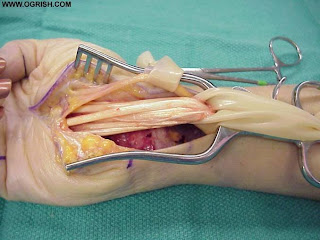


Surgery
Carpal tunnel release is one of the most common surgical procedures in the United States. Generally recommended if symptoms last for 6 months, surgery involves severing the band of tissue around the wrist to reduce pressure on the median nerve. Surgery is done under local anesthesia and does not require an overnight hospital stay. Many patients require surgery on both hands. The following are types of carpal tunnel release surgery:

Open release surgery, the traditional procedure used to correct carpal tunnel syndrome, consists of making an incision up to 2 inches in the wrist and then cutting the carpal ligament to enlarge the carpal tunnel. The procedure is generally done under local anesthesia on an outpatient basis, unless there are unusual medical considerations.

Endoscopic surgery may allow faster functional recovery and less postoperative discomfort than traditional open release surgery. The surgeon makes two incisions (about ½" each) in the wrist and palm, inserts a camera attached to a tube, observes the tissue on a screen, and cuts the carpal ligament (the tissue that holds joints together). This two-portal endoscopic surgery, generally performed under local anesthesia, is effective and minimizes scarring and scar tenderness, if any. One-portal endoscopic surgery for carpal tunnel syndrome is also available.

Although symptoms may be relieved immediately after surgery, full recovery from carpal tunnel surgery can take months. Some patients may have infection, nerve damage, stiffness, and pain at the scar. Occasionally the wrist loses strength because the carpal ligament is cut. Patients should undergo physical therapy after surgery to restore wrist strength. Some patients may need to adjust job duties or even change jobs after recovery from surgery.

Recurrence of carpal tunnel syndrome following treatment is rare. The majority of patients recover completely.

How can carpal tunnel syndrome be prevented ?
At the workplace, workers can do on-the-job conditioning, perform stretching exercises, take frequent rest breaks, wear splints to keep wrists straight, and use correct posture and wrist position. Wearing fingerless gloves can help keep hands warm and flexible. Workstations, tools and tool handles, and tasks can be redesigned to enable the worker's wrist to maintain a natural position during work. Jobs can be rotated among workers. Employers can develop programs in ergonomics, the process of adapting workplace conditions and job demands to the capabilities of workers. However, research has not conclusively shown that these workplace changes prevent the occurrence of carpal tunnel syndrome.

Thursday, October 6, 2016

Local Residents Find Carpal Tunnel Syndrome Helped By Chiropractor In Short Pump


By Samital Leah Zerna


When abnormal pressure is exerted on the median nerve, located right above the wrist, it may cause carpal tunnel syndrome. This condition affecting the hand is named for the median nerve, which it affects. Those who work on a computer all day are most often afflicted with this. At Midlothian Chiropractic in Short Pump the professionals ease the pain caused by this condition.

It can be caused by a trauma to the wrist or by repetitive stress. It may interfere with an individuals ability to hold down a job. It can even make dressing, eating or brushing your teeth clumsy to impossible. Often the person afflicted with this condition will drop things repeatedly.

A full nights sleep may be impossible since the pain can jolt you awake. Chiropractors have been successfully relieving the symptoms. They do so by adjusting misplaced vertebrae in the neck that are compressing the nerve roots. People prefer chiropractic intervention rather than invasive procedures or taking strong pain medication.

Symptoms most often have a slow onset with the discomfort growing until the numbness travels up the lower arm. It affects the palm of the hand and fingers with the exception of the little finger. In some people the cause is a fracture or rheumatoid arthritis. In others the cause is unidentifiable.

An entrapped nerve may be above the wrist or in the arm or neck. Compression causes this entrapment. It can affect one nerve or several. A combination of massage and adjustments to the cervical vertebrae may be required to alleviate the numbness and pain.

During your first office visit a full assessment of your condition is done. This will determine if the pain is due to carpal tunnel syndrome and what the appropriate care should include. Upon confirmation a plan can be made for your care. It might include a combination of adjustments to the cervical vertebrae and massage.


About the Author:


Sunday, August 7, 2016

Irritable Bowel Syndrome and Yoga


by Baxter

As I am preparing for my upcoming web talks on Yoga for Healthy Digestion for YogaU Online scheduled for July 23rd and 25th, I am rediscovering a lot about  both our digestive health and illness. Of particular interest is a very common gastro-intestinal (GI) condition called Irritable Bowel Syndrome, sometimes abbreviated IBS. The last time statistics were taken for this condition in the US, it was estimated that 15.3 million people suffered with IBS. It accounted for three million doctors office visits in 2004, 212,000 hospitalizations the same year, and 5.9 million prescriptions. Before we look at yoga’s potential impact on IBS, let’s take a look at how IBS shows up and what we know about its causes. According to the Mayo Clinic website:

“Irritable bowel syndrome (IBS) is a common disorder that affects your large intestine (colon). Irritable bowel syndrome commonly causes cramping, abdominal pain, bloating gas, diarrhea and constipation. Despite these uncomfortable signs and symptoms, IBS doesn't cause permanent damage to your colon.” 

For most students and patients of mine with IBS, it is a chronic condition that they have had since childhood or teenage years that fluctuates from day to day, week to week or month to month. I want to bring special attention that last comment in the quote: IBS does not cause permanent damage to your colon. This in contrast to the less common but more serious GI conditions like Crohn’s disease and other inflammatory bowel diseases that do damage the gut and can have life-threatening consequences. Maybe because IBS does not have such serious consequences, some health care professionals may minimize the impact of IBS. But those who suffer from it know it can be a source of daily discomfort and challenge.

Another aside: since the recent recognition of Celiac disease, gluten allergy and sensitivity and the ability to test for them, many patients previously with an IBS diagnosis have been found to actually be gluten allergic, or have Celiac Disease. This has resulted in a huge improvement in symptoms for these folks as they eliminate gluten-containing foods from their diets. So, if you have been told you have IBS and have not been tested for gluten, do so soon. Also, know that there are newer and more sensitive tests for Gluten allergy, and to learn more, listen to this KPFA broadcast from last week. The discussion is on Lyme disease, but gluten allergy/Celiac testing is also addressed at the start of the program from minute 8 through 22.

It is unclear what the cause of IBS is, but it may have something to do with the smooth muscle lining of the gut walls that helps to move digesting food downstream. In some people the wave of contractions may be too fast or too slow.  It may also be that the neurotransmitter serotonin may play a role in IBS, as a lot of it is found in the gut. The balance of gut bacteria may also be off in IBS. Triggers for IBS are varied and variable from person to person, and include gas or pressure on your intestines, or certain foods, medications or emotions. Hormone fluctuations, especially female ones (IBS is more common in women than men) and stress are also common triggers. The risk factors for IBS include age of onset before 35, being a woman, and having a first degree relative with IBS.

The yoga approach to IBS is similar to some of the posts where we have discussed healthy digestion and eating (see Healthy Eating and Your Digestive System, Meditation and Healthy Eating, and other posts under the label "healthy eating". 
  • If you think you may have food triggers, the increased awareness of your body and its reactions to foods you eat that develops with regular yoga practice can help you identify and eliminate your personal food triggers.
  • In my practice, I noticed that flares of symptoms are very often related to increased periods of stress in my students’ lives. The effective stress reducing benefits of yoga, either via a well balanced yoga asana practice, or a more focused restorative practice, yoga nidra or simple mindful meditation practices could all help bring your gut into better balance and reduce your symptoms. (See The Relaxation Response and Yoga.)
  • For a sluggish gut, with bloating and constipation, try Supta Baddha Konasana (Reclined Cobbler’s pose or Queen’s pose), and for an overactive gut with cramping and tendency for diarrhea, try Viparita Karani (Legs Up the Wall pose). 
  • If you have not taken the “tour of your GI tract” we posted a while back, you could use it as a guided meditation while setting yourself up in a supported Savasana (see the Audio Tracks tab at the top of the page to find this audio track). 
And if you want to learn more about Yoga for Healthy Digestion, look for the free interview coming up in the next week or so on YogaU Online, and my more detailed two-night lecture on July 23 and 25th, 8:30-9:30 EST (see here).

Subscribe to Yoga for Healthy Aging by Email ° Follow Yoga for Healthy Aging on Facebook ° Join this site with Google Friend Connect

Tuesday, July 5, 2016

What is Shaken Baby Syndrome SBS


[Extracted from MedicineNet.com]

Shaken baby syndrome is the term that is used to describe a form of child abuse caused by vigorously shaking an infant, often in anger, to get a child to stop crying or whining. It usually occurs in children less than 01 year of age, and the violent shaking often results in severe and permanent brain injury, spinal-cord injuries, bleeding in the eyes (retinal hemorrhages), and even death.

How common is shaken baby syndrome ?

There are no accurate statistics, but experts estimate the incidence to be between 1,000 to 1,500 infants per year. According to the Centers for Disease Control and Prevention, of the almost 2,000 children who die from abuse or neglect each year, shaken baby syndrome accounts for 10%-12% of them. Most commonly, the victim of shaken baby syndrome is between 03 and 08 months old; however, it has been reported in newborns and in children up to 04 years of age. In addition, 25% of all children diagnosed with shaken baby syndrome die from their injuries.

What causes shaken baby syndrome ?

Infants have very weak neck muscles and large and heavy heads in proportion to their bodies. In addition, because the infant brain is immature and needs room to grow, there is naturally a virtual space between the skull and brain to allow for development. Violently shaking an infant can cause the brain to move within the skull, resulting in cerebral contusions (bruising of brain tissue) and shearing (tearing) of blood vessels. Most commonly, the injuries associated with shaken baby syndrome include bleeding around the brain (subdural and subarachnoid hemorrhages), bleeding in the eyes (retinal hemorrhages), and spinal cord or neck injuries. Often infants will also have evidence of other non-accidental injuries, including unexplained bruises, rib fractures, or extremity fractures.

What are the symptoms and signs of shaken baby syndrome ?

The injuries associated with shaken baby syndrome may not be immediately noticeable. Infants may present with nonspecific complaints, such as irritability or vomiting. These symptoms are caused by the developing increased pressure within the brain (intracranial pressure) caused by brain hemorrhages and swelling. These infants often develop additional symptoms, such as lethargy, breathing difficulties, and seizures.

What are the treatments for shaken baby syndrome ?

Infants with injuries of shaken baby syndrome require emergency care, including respiratory support and surgery. Often these infants require draining of the blood around the brain to decrease the ongoing brain injuries associated with brain swelling. Additional treatments may be required as well, including obtaining ophthalmologic and neurological evaluations.

What is the prognosis for shaken baby syndrome ?

Infants who have suffered injuries as a result of this type of child abuse have a poor prognosis. Of those infants who survive, many will have permanent brain damage, retinal injuries, and blindness as well as and neck and spinal injuries. Unfortunately, the damage to the nervous system is too frequently permanent.

Can shaken baby syndrome be caused accidentally ?

Shaken baby syndrome is almost always a result of child abuse, often perpetrated by a parent or caregiver who shakes an infant angrily in response to persistent crying. In very rare cases, the injuries associated with shaken baby syndrome may be caused by accidental actions, such as jogging with a newborn baby in a backpack. It does not result from gentle play or bouncing a child on a knee. Even in those rare accidental cases, the injuries are rarely as severe as those cases associated with non-accidental trauma from shaken baby syndrome.

Can shaken baby syndrome be prevented ?

The following are guidelines to prevent child abuse and shaken baby syndrome

a) Never shake an infant or child.

b) Avoid holding your infant during arguments.

c) Avoid disciplining your child when you are angry.

d) Report abuse to the local police or to your state's child protective services if you suspect that a child in your home or someone you know is a victim of child abuse.

e) If you find yourself becoming increasingly short-tempered around your infant or child, take a break and ask a friend or family member for help.

f) Support the passage of the shaken baby syndrome Prevention Act (S 1204, HR 2052) introduced last year by writing your state senator and congressman.

Shaken baby syndrome is a form of child abuse in which violent shaking of an infant causes the brain to move inside the skull, causing bruising of the brain and tearing of blood vessels. The shaking results in bleeding around the brain, bleeding in the eyes, spinal cord and neck injuries, bruises, and rib fractures. Infants who survive may suffer brain damage and blindness.