Showing posts with label Q. Show all posts
Showing posts with label Q. Show all posts
Monday, June 12, 2017
Friday Q A Larger Women
Q: Do you know if Baxter is going to talk more about teaching to larger women? I had a class at Piedmont Yoga Studio for larger women and I think one problem that was overlooked was that larger women “seemed” to be more flexible in certain areas where they oftentimes were hanging on their ligaments from bearing the weight. I remember at the beginning these women were so “proud” that they were able to do certain things but we had to work on containment. At the time I was one of the larger students and so I learned this firsthand.
Briefly it happens most in poses that require external rotation in the legs as many larger people are already overly externally rotating. The solution is to make them consciously aware of this and start to work on not going to the extreme in these rotations and then working on internal rotations (oftentimes using straps and blocks) to build those muscles up so there’s more balance.
This happens both in standing poses as well as others, such as Supta Padangusthasana and even Child’s pose. The knees in Child's pose are so externally rotated that it’s no wonder there are so many knee problems. Baxter can probably address the knee problems too as I've seen many larger people hyper-extending in the knees, again putting so much stress.
A: Thanks so much for your helpful comments! It’s always great to get feedback from someone who has worked first hand with a particular group and who also has personal experience. Yours are very accurate observations. It seems to me that people with larger body mass in the lower belly and thighs, either because recent weight gain or a lifetime of being heavy, tend to push the belly and thighs apart through external rotation. The result is a “functional” imbalance (overly externally rotating) that can be brought back into balance, as you have pointed out.
But I would also like to add that I’ve also observed among the larger students that, just like any group of students, there are some people that have the opposite problem: very limited mobility. This is due to stiffness in their muscles, as it is for the general population, and is not related to their weight. So until we have more evidence about trends for larger people, it is best for all of us not to make assumptions about any individuals or ourselves. Instead, always start with your own observations about yourself (or your students).
—Baxter
Subscribe to YOGA FOR HEALTHY AGING by Email ° Follow Yoga for Healthy Aging on Facebook

Tuesday, May 30, 2017
Friday Q A Stretching Science and Autoimmune Diseases
Q: I'm wondering to what extent, and at what rate, we should expect to be able to increase our flexibility as we continue to age. I've made significant progress over the years, and have generally learned how to be mindful enough not to overdo. However, every so often I overstretch without realizing it - whether it's my back trying to get a fuller forward bend, or my Achilles tendon while pushing the envelope. I'm in my 50s and have been doing regular yoga for about 5 years. It's made an immense difference in my core strength and balance and flexibility and I'm much less injury prone now. And yet, every so often, it's my yoga practice that puts me out of commission.
A: Baxter and I discussed your question, and he agrees with me that there is no fixed extent or rate for increasing flexibility as we age, as this will differ from person to person. His advice is to maximize the effectiveness of your stretches while minimizing potential injury by holding your stretches longer rather than pushing harder. He mentioned that it takes at least 45 seconds to get your muscle to fully release. And my kinesiology teacher taught me that in order to change the resting length of the muscle (the length the muscle returns to after stretching), you need to stretch it for 90 seconds. So I use a timing of 90 seconds for many of my stretches. —Nina
Q: Does yoga have any good stretches for a 60 year old stiff person?
A: Yoga has a very large number of poses that allow you to stretch a very wide variety of muscles, no matter how stiff you are. So the first question to ask yourself is: where exactly am I stiff? Some of us are stiff all over and some of us are flexible all over, but it turns out that many of us are flexible in some areas and stiff in others. Identifying which areas you need to stretch will help you chose the poses that will be most helpful to you. That being said, there are a couple of poses that we highly recommend for their versatility. Downward-Facing Dog pose is especially wonderful because it stretches your legs, hips, shoulders and arms, all at the same time.
 If this pose is too demanding, you can do an easy variation, Half Dog pose (also called Right Angle pose). With your hands at shoulder-height on the wall or resting on the surface of a table, walk back so your hips are directly over your feet and your arms are parallel to the floor.
 Baxter recommend that you warm up for these poses with some dynamic movement, such as swinging your arms above your head or moving your legs around in your hip joints. —Nina
Q: How would one go about investigating the effects of yoga on aging scientifically?
A: This question is intriguing and so important that Brad will devote an entire post to the subject sometime soon.
Q: Just curious about how autoimmune diseases are related to aging? Some seem to be inflammatory conditions I think, and that makes me wonder about allergies, yoga and aging.
A: This is a very big and complicated question! And there’s no quick, simple answer, as the mechanisms behind many of these diseases (not to mention aging itself) are not fully understood. But Baxter says, “Not all autoimmune diseases are created equal.” Different autoimmune diseases arise at different stages in life, so not all are related to aging. Also, not all are related to inflammatory conditions. So that’s why we’ve decided that on this blog we’ll discuss the autoimmune diseases associated with aging individually, over time. Is there any particular disease that concerns you?
We are going to try to do a Q&A every Friday, so keep the questions coming. You can leave a question in a comment or you can email us at nina@wanderingmind.com.
Subscribe to Yoga for Healthy Aging by Email ° Follow Yoga for Healthy Aging on Facebook ° Join this site with Google Friend Connect
Q: How would one go about investigating the effects of yoga on aging scientifically?
A: This question is intriguing and so important that Brad will devote an entire post to the subject sometime soon.
Q: Just curious about how autoimmune diseases are related to aging? Some seem to be inflammatory conditions I think, and that makes me wonder about allergies, yoga and aging.
A: This is a very big and complicated question! And there’s no quick, simple answer, as the mechanisms behind many of these diseases (not to mention aging itself) are not fully understood. But Baxter says, “Not all autoimmune diseases are created equal.” Different autoimmune diseases arise at different stages in life, so not all are related to aging. Also, not all are related to inflammatory conditions. So that’s why we’ve decided that on this blog we’ll discuss the autoimmune diseases associated with aging individually, over time. Is there any particular disease that concerns you?
We are going to try to do a Q&A every Friday, so keep the questions coming. You can leave a question in a comment or you can email us at nina@wanderingmind.com.
Subscribe to Yoga for Healthy Aging by Email ° Follow Yoga for Healthy Aging on Facebook ° Join this site with Google Friend Connect
Thursday, March 9, 2017
Friday Q A Timing Your Yoga Poses
Q: You sometimes suggest staying in a pose for about 90 seconds. Is there a way you tell that it’s 90 seconds? Sometimes 90 seconds is a long time and sometimes it is fleeting.
I don’t want to stare at the second hand of a clock – which seems to negate many of the benefits. I set my cell phone alarm when I mediate but I don’t want to reset it every 90 seconds for this purpose - again, there goes any peace.
While I don’t want to obsess about time, I don’t want to stop at 20 seconds when I can do more. I’m not talking about working through pain or discomfort. It’s not my body as much as my mind.
I’m having difficulty articulating my question clearly; I hope it makes sense to you.
A: Fortunately, there is any easy answer to your question! If you don’t want to use a countdown timer to time your poses, you can count your breaths. This is not only simple but has the added benefit of focusing your attention on your breath, making your practice a more mindful experience.
The first thing to do is to figure out how many breaths you take per minute. Since the number of breaths you take per minute varies with the type of pose that you’re doing, you should take about three measurements. Using a timer set for one minute, count your natural breaths in:
- a simple seated pose
- a comfortable stretching pose
- a vigorous standing pose, such as Warrior 1
When you want to increase your endurance in difficult poses, counting your breaths is a great way to time yourself. Each month, for example, you could add one more breath to your count, and over time you would quite gradually be increasing your time in the pose and building your strength.
For restorative poses, where you are going to hold the pose for several minutes, you may prefer to use a timer. But it’s completely up to you.
—Nina
Subscribe to Yoga for Healthy Aging by Email ° Follow Yoga for Healthy Aging on Facebook ° Join this site with Google Friend Connect
Friday, January 20, 2017
Friday Q A Why Only Women in Your Photo Contest
 |
| Joy Sassoon, Age 60 by Tanya Constantine |
A: The simple answer is that if you scan through the posts on our blog, you will see a preponderance of photos of a white man in his 50s (Baxter Bell). So, to start, I wanted to get a bit more diversity on the blog and I decided to start with women (of all colors and body types).
 |
| Karen Moore by Melina Meza |
However, there have been some complaints about lack of equality in this contest, so because I've received an outpouring of photographs of older woman doing yoga, I've decided that after I'm able to sort through all those photos and have posted a significant number of them, I will open the contest to men. Stay tuned!
 |
| Vincent, Age 51 Copyright by Sara Bennett 2013 |
P.S. I received the following comment on Tuesday's post:
"Although I love the women models I do not like the listing of their ages. If you added a caption with the age of all your models, it would be more balanced. Noting only the ages of women, and only older women, is feeding the 'anti aging' paradigm we would like to avoid."
This comment confused me. I thought women proudly stating their age was a good thing, as we are often taught to lie about our ages or be ashamed of being older. What do you think? Should I include the ages or not? (Of course, if I continue including the women's ages, I would also include the ages of men whose photos I post after that contest begins. I won't be posting Baxter's age on every single photo of Baxter, however, because I considered the photos of people demonstrating our poses to be in a different category.)
Subscribe to Yoga for Healthy Aging by Email ° Follow Yoga for Healthy Aging on Facebook ° Join this site with Google Friend Connect
Wednesday, January 18, 2017
Friday Q A Breath Practices that Stimulate or Invigorate
 |
| Ladders Cross the Blue Sky in a Wheel of Fire by Joan Miro* |
Q: I am teaching a Pranayama workshop and linking it to Brain Physiology. I checked this article and I am confused. According to your article, inhalation stimulates the SNS (sympathetic nervous system) and exhalation triggers PNS (parasympathetic nervous system). Is this your personal experience or are you pretty sure about this correlation because I did not find this in any Yoga textbooks or articles.
Just think about Kapalabhati Pranayama: The inhalation is very passive and exhalation is very forceful. If your correlation is true, at the end of Kapalabhati pranayama, you need to feel more relaxed and calm (exhalation-PNS). But this is not what we typically experience. The nature of Kapalabhati pranayama is such that it makes an individual more active, there is more heat generated in mind and body and it awakens an individual from stupor. I guess this is due to activation of SNS. So this would be contradictory to what you mentioned. What is the correct explanation?
A: I love it when my readers take some aspect of the practice of yoga and begin to look a little deeper! I just reread my post How Your Breath Affects Your Nervous System on the effect of the length of the inhalation/exhalation (like a five-minute pranayama practice of one second inhalation and two second exhalation, for example) over time and the indirect influence it has on the brain and the “tone” of the autonomic nervous system (ANS). The length of your inhalation and/or exhalation influences your heart rate (cardiovascular system) by slowing or speeding it up, which then has a feedback effect on your brain’s perception of safety or danger, activity or rest, and may then shift the overall balance of your sympathetic/parasympathetic tone in one direction or the other. This assumes the person doing the pranayama does not have any other factors at play that might be more activating or quieting to their nervous system. For example, a new practitioner unfamiliar with breathing practices might be nervous and anxious about getting the practice right, and a breath ratio, such as 1:2, that might normally turn on the parasympathetic parts of the the ANS could be overridden by the background mindset of the person practicing it and actually stimulate the sympathetic nervous system instead.
In fact, the Autonomic Nervous System is by no way a simple system of the Fight or Flight response (sympathetic nervous system) being turned on and the Rest and Digest response (parasympathetic) being turned off, or vice versa. The ANS is much more subtle and nuanced than that. Why, just this past week, anatomy teacher and yogi Leslie Kaminoff’s colleague Amy Matthews wonderfully articulated this concept in this video clip.
As for the other kinds of breath practices our reader mentions, such as Kapalabhati pranayama, where the practitioner is quickly exhaling audibly, and quietly and more passively allowing the inhale to happen, and doing so at a pace that can be slower at first for newer practitioners or much faster in pace for more experienced practitioners, the typical effect is more stimulating for the ANS.
This means that for most people doing the practice, the sympathetic nervous system is likely going to be stimulated more. Even here, I could argue that the inhale/exhale length effects described above for slower kinds of pranayama techniques might still have an effect: the exhalation is short and quick, and the inhalation, which is not as audible as the exhalation, is probably a little longer in length than the exhalation. Done over several minutes, this could support the increase in stimulation of the sympathetic nervous system. In addition, the abdominal muscles are actively contracting to assist in the that quick exhalation, so you are asking your body to “work” more, which also will likely stimulate the sympathetic system a bit more.
This would be true also for Bastrika pranayama, where both the inhalation and exhalation are quick and audible.
In Bastrika, the length of the inhalation and exhalation are about the same, so you would not see the same influence of the length of the inhalation relative to exhalation that you do in Kapalabhati or the 1:2 ratio example I gave before. But because your abdominal muscles are so actively assisting the process, it is going to be more stimulating than quieting to your nervous system.
In all of this, keep in mind that it is not a simple formula of “this leads to that.” You will need to consider many factors when anticipating the effect that any particular breath practice might have, and, after practicing, also assess for yourself whether your predicted effect, either stimulating or quieting, really played out in the end!
—Baxter
Subscribe to Yoga for Healthy Aging by Email ° Follow Yoga for Healthy Aging on Facebook ° Join this site with Google Friend Connect
Monday, January 16, 2017
Friday Q A Dangerous Poses for Osteopenia
Q: Could you please post an article discussing dangerous yoga positions for women with osteopenia in the spine? I am a 57 yr old woman with a -1.7 T score (?) for my spine on my last DEXA scan. I am doing the yoga poses for strengthening bones in Loren Fishman's “Yoga for Osteoporosis.” I can easily do most of the versions of the poses for osteopenia, but worry about doing the classical poses, especially the twists and those involving forward flexion. I would love to hear your views on this.
A: I’ll start by addressing why it may be dangerous for people with osteoporosis to do spinal flexion (forward bending of the spine). When we round the spine into a flexed position, such as in a seated forward bend, the front of the vertebral bodies will have more weight than the back of the vertebral bodies, and this uneven weight bearing is the potential culprit for causing vertebral body fractures.
Additionally, in osteoporosis there are often changes in the spinal curves, and an increase in thoracic kyphosis occurs with a decrease in lumbar lordosis. This is commonly due to loss of vertebral disc height and to poor posture with postural adaption due to decreased back extensor strength. The changes in the spinal curves will cause a “wedging.” The change in the vertebral body shape cannot sustain the biomechanical loads generated in forward bends when the spine flexes. The postural changes may also be associated with shortening of the trunk flexors (the abdominal and hip flexor muscles), so when we bend forward and our spine rounds, the muscle contraction of the front trunk muscles puts more pressure on the front of the vertebral bodies and this also increases fracture risk.
Dr. Loren Fishman cites that decreased back extensor strength predisposes individuals with osteoporosis to a three times higher fracture risk than individuals with strong back extensors who do not have osteoporosis. Some yoga teachers are absolute in preventing students who have had prior vertebral fractures from doing ANY poses that cause spinal flexion. That would include either single or double Knee to Chest, Reclined Leg Stretch series (Supta Padangusthasana), and Child’s pose (Balasana). However, I am a proponent of learning to move from your hip joints and keeping your spine in neutral (not rounded) when working in forward bending positions. In my mind, rolling in bed, getting out of a car, or getting up from a low couch may present more fracture risk than a mindful, slow yoga practice!
Now, what about twisting? How you twist and how you move into a twist are the crucial elements for osteoporosis safety. Twists involve compression, bending, torsion and bone shear, which is stimulating to bone growth. However, if you use your arms and force yourself into a twisted position, you are running a risk of fracture and more. Body parts do not like to be forced into any positions! On the other hand, if you use your breath, awareness and move SLOWLY into a twist position without using your arms to leverage the twist, your fracture risk is much reduced. Paying careful attention to maintaining your neutral spinal curves prior to the twist is also important.
I hope this helps you with your practice!
—Shari
Subscribe to Yoga for Healthy Aging by Email ° Follow Yoga for Healthy Aging on Facebook ° Join this site with Google Friend Connect
Monday, December 26, 2016
Friday Q A Aging Muscles Bones and Joints
 |
| Adam and Eve by Lucas Cranach the Elder |
- Yoga for Strength: An Overview
- Yoga and Flexibility: An Overview
- Healthy Bones for Men and Women Alike
- What is Osteopenia? How Can Yoga Help?
- Yoga for Osteoarthritis
—Baxter
Subscribe to Yoga for Healthy Aging by Email ° Follow Yoga for Healthy Aging on Facebook ° Join this site with Google Friend Connect
Friday, December 2, 2016
Friday Q A Why Focus on Yoga for Healthy Aging
 |
| Young & Old Irises by Melina Meza |
A: It is always hard for me to tell if I choose my specialty or the specialty chooses me! When I was in medical school, I thought I was going to choose to do a surgical specialty, as I was good with my hands and there was a kind of mystic healing that took place in the surgical suite. Yet, as I was exposed to all the different specialties of medicine in my training, I felt a new calling from family medicine. I realized I could affect so many more people, and of all ages. I enjoyed working with infants, children, teenagers, young adults, and older adults, so family practice kind of choose me.
With yoga for healthy aging, there was a similar draw. As I finished my yoga training, I was again thinking of how my new passion, yoga, and its health promoting and healing potential could reach the largest audience possible. And as I worked with yoga for the first 16 years of my practice, age itself may have been choosing this path.
And isn’t the concept of aging intriguing? At face value, from the day of conception, each of us is aging each and every day. The first 18 years or so of our lives are mostly about growth towards our adult bodies and brains, so aging is exciting, as we get closer to becoming mature adults—often considered a desirable threshold. Then, as we enter our young adult years, finding our place in society, and our first careers and important relationships, age seems have a neutral reputation for a while. And somewhere in mid-life, we realize we have been around a while and even begin to contemplate if and when this life might be over, and age’s reputation starts to tarnish. But all the while, we are getting one day older with each spin of the planet. And sometimes we are in good health, and sometimes we are faced with the myriad of physical, mental and emotional challenges humans fall prey to. Life.
I added yoga into the formula of my life around age 34, and have been reaping the rewards ever since, the ones we write about each week—flexibility, strength, balance, and agility, as well as the stress managing benefits and the sense of equanimity in the face of ever changing circumstances. But I have also seen these same benefits in the very young, the teenager, the young adult, and the much older adult who take up the yoga practice and make it a regular part of their lives. It’s quite powerful! So I want to inspire and teach as many people out there as possible about the wonderful potential yoga has for us as we travel our lifetimes. So, that is at least part of the reason why I have chosen to “specialize” in yoga for healthy aging. Thanks for asking and prompting me to sit and reflect in this immensely gratifying journey I am on with yoga.
—Baxter
Subscribe to Yoga for Healthy Aging by Email ° Follow Yoga for Healthy Aging on Facebook ° Join this site with Google Friend Connect
Thursday, September 15, 2016
Friday Q A Trauma Resurfacing Crying in Class Part 2
 |
| Morning Glories by Melina Meza |
—Nina
"Thank you for this post; I think lots of teachers will benefit as I've seen little written about it. This line of Baxter's really resonated with how I feel on the topic: "I try not to pacify or console, or imply that I know what they are going through, but continue to cultivate a safe environment for them to experience their full practice." Creating a safe space for the more intense moments of the practice to be digested is key, and I believe is often what enables them to come up for people in class in the first place. I find it useful to let students know that when practicing yoga over a series of years almost every emotion available will be experienced to some degree and that crying from sadness or any other emotion can be a healthy and useful way to process those emotions or experiences that arise. I wonder if saying even that much goes outside scope of practice, but nonetheless it's been beneficial for students who have cried in class to hear and understand so they don't feel there is something wrong with their practice or something that needs fixing. Nina, thank you for the resources for better supporting those working with a history of trauma. The front body protected poses are excellent reminders." —Kate
"Thank you for this important post. I think we will be seeing much more about the benefits of a yoga practice for trauma survivors. I can highly recommend the book by Emerson and Hopper, and the training through the Trauma Center at JRI. As an adjunct to talk therapy, I believe yoga is a powerful ally in the treatment of trauma, and hope that more people will become aware of its benefits. In those cases, making sure that the student is already actively in therapy is vital, so that what comes up in yoga class can be processed safely with a trusted professional. In my experience so far, your advice about child's pose (and front body protecting positions) is spot on – although, naturally any pose could trigger emotions and memories, as each individual's experience is unique. As the original commenter stated, I agree that there are likely many more trauma survivors in our classes than we realize, and although there is no way of knowing the reason for the spontaneous tears in class, I think it's a gift for any practitioner to be in an environment where experiencing and expressing emotions is welcomed and not judged – something that all yoga teachers can strive to provide." —Mary
"Thank you for this post; I think lots of teachers will benefit as I've seen little written about it. This line of Baxter's really resonated with how I feel on the topic: "I try not to pacify or console, or imply that I know what they are going through, but continue to cultivate a safe environment for them to experience their full practice." Creating a safe space for the more intense moments of the practice to be digested is key, and I believe is often what enables them to come up for people in class in the first place. I find it useful to let students know that when practicing yoga over a series of years almost every emotion available will be experienced to some degree and that crying from sadness or any other emotion can be a healthy and useful way to process those emotions or experiences that arise. I wonder if saying even that much goes outside scope of practice, but nonetheless it's been beneficial for students who have cried in class to hear and understand so they don't feel there is something wrong with their practice or something that needs fixing. Nina, thank you for the resources for better supporting those working with a history of trauma. The front body protected poses are excellent reminders." —Kate
"Thank you for this important post. I think we will be seeing much more about the benefits of a yoga practice for trauma survivors. I can highly recommend the book by Emerson and Hopper, and the training through the Trauma Center at JRI. As an adjunct to talk therapy, I believe yoga is a powerful ally in the treatment of trauma, and hope that more people will become aware of its benefits. In those cases, making sure that the student is already actively in therapy is vital, so that what comes up in yoga class can be processed safely with a trusted professional. In my experience so far, your advice about child's pose (and front body protecting positions) is spot on – although, naturally any pose could trigger emotions and memories, as each individual's experience is unique. As the original commenter stated, I agree that there are likely many more trauma survivors in our classes than we realize, and although there is no way of knowing the reason for the spontaneous tears in class, I think it's a gift for any practitioner to be in an environment where experiencing and expressing emotions is welcomed and not judged – something that all yoga teachers can strive to provide." —Mary
Subscribe to Yoga for Healthy Aging by Email ° Follow Yoga for Healthy Aging on Facebook ° Join this site with Google Friend Connect
Tuesday, September 6, 2016
Friday Q A Standing Hunting Dog Pose
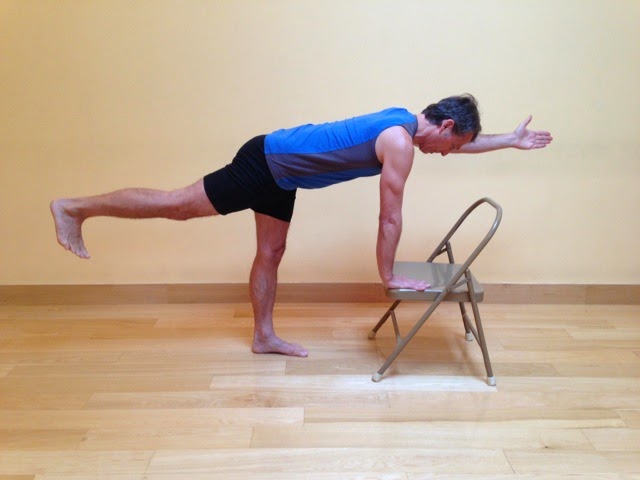
A: Do I have a variation for those who can’t be on their knees?! Why, of course I do! Before I get to that, let’s review the benefits and challenges of the full Hunting Dog Pose. As I shared with you in Featured Pose: Hunting Dog Pose, Hunting Dog pose is a great precursor to strong poses like Warrior 3 and is a wonderful way to tone and strengthen your upper body, especially the Serratus Anterior muscles, as well your pelvic stabilizers and core belly muscles. It’s also a good pose for improving core strength as well as strengthening the lower back. I prescribe this pose for:
- lower back pain
- balance issues
- fatigue (when standing poses are too tiring)
- improving right/left coordination
- building arm strength
As most of you probably already know, you do the full pose by starting in Hands and Knees position. You then take one leg back and up parallel with the floor and your opposite arm up and reaching forward while keeping your torso and belly engaged in a neutral arch of your lumbar spine. Usually you hold the full pose for a while and then lower your arm and leg, and repeat on the other side.
For those who cannot be on their knees, assuming that they cannot bear pressure on the shin and knee or are unable to fully bend the knees to 90 degrees due to arthritis, injury, or other causes, I suggest the following:
1. Start in Mountain pose (Tadasana), about a foot or so from the seat of a chair or another strong prop that is high enough to allow you to keep your torso and abdomen about parallel with the floor when you place your hands on it.
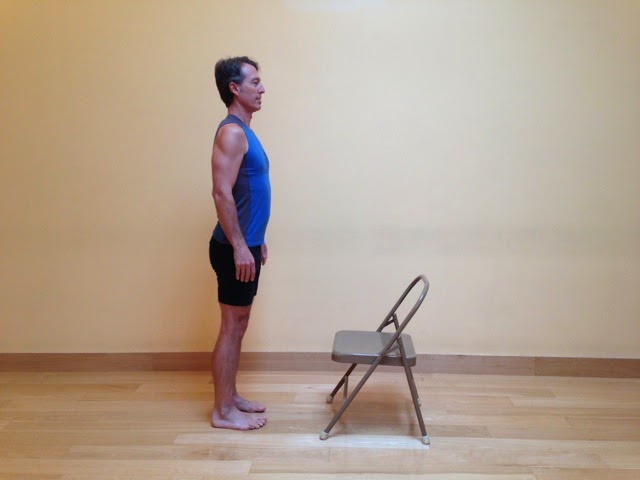
2. From Mountain Pose, come into Half Standing Forward Bend (Ardha Uttanasana) and place your hands on the chair seat. Check whether your torso and abdomen are about parallel with the floor, stepping further away from the chair if necessary.

3. Step your feet a bit closer together than hip-distance apart and lift your right leg up to near parallel with the floor, or in line with the angle of your torso, without changing your hip position or the arch in your spine.

4. Firm your right elbow joint and keep your chest lifting up into your right shoulder blade as you reach your left arm forward and parallel with the floor. Keep your head in line with the rest of your spine.

5. Hold the pose for 6-12 breaths before returning your raised hand to the chair and your raised foot to the ground.
6. Bend your knees slightly and come up to Mountain pose for a few breaths before repeating on the second side.
Because your legs are straight in this version and you are farther from the ground than in classic Hunting Dog pose, your lifted leg and its supportive muscles will be working harder than in the kneeling version. So when you are initially practicing this pose, you may want to stay for shorter periods of time and gradually build up to longer holds. And you may need to do more warm ups for both legs before trying it in a practice. I’d recommend stage one of Reclined Leg Stretch pose to get the feeling of separating your two legs that you will experience when you flip upside down for the standing version of Hunting Dog pose.

Have fun, and let me know what you think!
Subscribe to Yoga for Healthy Aging by Email ° Follow Yoga for Healthy Aging on Facebook ° Join this site with Google Friend Connect
Wednesday, August 31, 2016
Friday Q A Psoriasis and Yoga

A: Psoriasis, probably due to so many TV ads about over-the-counter treatments over the years, is a word most of us have heard before. “The heartbreak of psoriasis” still rings in my ears when I think about those ads! But what is psoriasis, really, and how could yoga practices influence its course?
Psoriasis is primarily a skin condition that has a very distinct pattern, which involves thickened patches, called plaques, which often, but not exclusively, appear over the boney areas around the joints. You may have even seen someone with this affecting their elbows, as this is likely the area of the body that would be exposed to your view, especially in short-sleeve shirt seasons. According to the Mayo Clinic:
“Psoriasis is a common skin condition that changes the life cycle of skin cells. Psoriasis causes cells to build up rapidly on the surface of the skin. The extra skin cells form thick, silvery scales and itchy, dry, red patches that are sometimes painful.”
Some would consider the patches unsightly, perhaps, but is likely the itching and pain that are going to be of more importance in leading to treatment of the condition for those who have it. It is a chronic condition without a cure at this time. Treatments your doctor may offer are directed at addressing the plaques and stopping the skin cells from growing so quickly. Even over the counter steroid creams and exposure of the skin to natural sunlight may help.
In addition to plaques on the joints, patches of psoriasis can also occur on the neck, in the scalp, in the folds of flesh, such as under the breasts, and on the fingernails. This varies from person to person. You are usually encouraged to seek medical attention if your patches go beyond simple itching and are painful and uncomfortable, if they interfere with your daily activities, or if you find the appearance troubling.
Although not fully understood, psoriasis is at least partly an autoimmune disease, where your immune system mistakes your cells for outside invaders. In this case, your specialized white blood cells known as T cells attack your healthy skin cells by mistake and start the inflammatory ball rolling. Yoga has been shown to have a beneficial effect on supporting a healthier immune system, so this may be one way in which yoga could be of benefit to psoriasis sufferers.
It also turns out that certain “triggers” can lead to flares in these people. Some of these triggers include: trauma to your skin (for example, from bad sunburns, scrapes, insect bites, or cuts), acute infections, heavy alcohol use, smoking, and even cold weather and good old stress. As we have often written about here at YFHA, yoga has been demonstrated to reduce stress levels, and the mindfulness skills of yoga could lead to improved self awareness that could improve your chances of identifying a trigger sooner and addressing it before it worsens you skin condition. Yoga practices can also support changing unhealthy lifestyle choices, such as smoking, and could help alcoholism and/or heavy alcohol use.
Some of these triggers also turn out to be risk factors for developing psoriasis in the first place, such as unaddressed stress and smoking. In addition, a family history of one parent or both parents having psoriasis is the biggest risk factor for developing it yourself. Obesity is another risk factor, as is serious infection like HIV, or people with recurring infections, such as ongoing strep throat. Yoga, again, can be helpful in addressing stress, smoking and can be helpful in some instances if you desire to lose weight.
It has also been observed that people with ongoing psoriasis can lead to other quality of life issues that put you at greater risk for low self-esteem, depression, or social isolation. The successes one might experience in a regular yoga class might lead to improved self-esteem, and regular attendance of a public class could help combat social isolation. And depression has been studied and found to improve with yoga, so even more reasons for adopting a regular practice!
Finally, there is a complication of psoriasis known as psoriatic arthritis, in which the psoriasis causes the same kind of damage to your joints as regular arthritis, leading to pain and dysfunction in your joints. This can be debilitating in more extreme cases. We have written about how yoga can be beneficial for arthritis in these past posts, so to learn more about yoga for arthritis, check out Yoga for Osteoarthritis and our posts on arthritis of specific joints, such as hands or spine (see How to Search).
The biggest caution for someone with active psoriasis who is just starting to do yoga would be making sure the poses you practice do not aggravate your skin symptoms. For example, if you had painful patches on your elbows, practicing forearm balance, which involves pressure and tension on the skin around the elbows, might not be a good idea—at least not while the area is painful or raw. This may seem like a common sense recommendation, but it seems worth stating just in case.
All in all, yoga seems like a good addition to the western medical treatments that someone with psoriasis is already receiving. I know of a few of my students who have psoriasis and they seem to be enjoying regular practice. And I would love to hear from any of our readers who have psoriasis. Has yoga had noticeable positive effects on the course of your psoriasis?
—Baxter
Subscribe to Yoga for Healthy Aging by Email ° Follow Yoga for Healthy Aging on Facebook ° Join this site with Google Friend Connect
Saturday, August 27, 2016
Friday Q A Finding a Safe Yoga Class
 |
| In the Yoga Studio by Melina Meza |
A: In general, yoga classes provide more benefits than safety concerns, as long as you can find the right class for where you are starting. In the past, we have discussed the issue of staying safe in a yoga class from a few of different perspectives (see Take Care of Yourself or Your Students, 9 Tips for Being a Good Yoga Student and Resting Between Poses), but today I’d like to try and sketch out a more complete, three-step approach to keeping yourself safe in a yoga class. And this approach should start even before you walk into your first yoga class or any new yoga class....
1. Vet the Yoga Studio
Before you even attend a class for the first time, it is a good idea to visit the website of a potential studio to:
- Check how long the studio has been in business. It is generally better to attend classes at a studio that has been in business for a while. If the studio is new, at least try to find a teacher who has significant teaching experience.
- Review the bios of the teachers, with particular interest in how long potential teachers have teaching and what type of training they received. See Finding the Right Yoga Teacher and Friday Q&A: Finding a Yoga Teacher for information about choosing the right teacher for you.
- Look over the class schedule to see if the studio offers beginning level classes or an introductory series (highly recommended for beginners!), and specialty classes that might meet your unique needs, such as a Back Care class if you have low back issues, or, if you are an older adult, do they offer special classes for your age group?
- clean, non-slippery floors (such as wood, bamboo, or thin carpeting—no thick carpets)
- yoga props (these will help the teacher keep you safe)
- clearly marked exits
- adequate and accessible restrooms?
- fire extinguishers
- a first aid kit (if that’s important to you)
2. Vet the Class and the Teacher
If you're very concerned about safety, another great way to screen for an appropriate class is to ask to observe the classes you are most interested in trying out. If you get the OK to do so (usually a good sign), try to arrive a bit early and get a good vantage point in the back of class so you can see the room well. Introduce yourself to the teacher and after sharing with the teacher any injuries or health issues you are dealing with (see What Your Teacher Really Wants to Know), ask if this class would be appropriate given your circumstances. Notice if the teacher addresses your concerns.
Then, as the students come in, notice if the teacher greets the students individually, and for new students, does he or she ask for the student’s name, and inquire as to any injuries or health issues? During the class, does the teacher give individual attention or recommendations to the students? Does the teacher offer a variety of options for the poses for those with varying degrees of ability?
Try to assess whether the level of difficulty of the class and the pace at which it is taught seem possible for you to try safely. Are there props offered to make the yoga poses more accessible for those with physical limitations?
Do you feel that there is adequate room around each student’s personal practice space—the yoga mat and the immediate area around each student—for everyone to practice safely without having to worry about the wayward limbs of a neighboring student? You will discover that there are some very popular classes, by virtue of the time of day they are offered or the popularity of the teacher, which can be quite crowded. So you need to decide if the space-to-student ratio is good for where you are at in your learning curve.
Finally, do you get a sense that the teacher is not only concerned with student’s physical safety in exploring yoga asana but is also nurturing the growth of the students with an appropriate mix of encouragement? This may not become totally apparent until you actually take a few classes, but is worth considering as you settle into a regular public class.
3. Vet Yourself!
An important aspect of staying safe in a yoga class is the issue of self-responsibility.
Start by considering your motivation. Why do you want to take the class? To lose a few pounds, to get stronger or more flexible, to improve your balance, or to lower your stress? Knowing why you are interested in the class will go a long way in guiding you to find the most appropriate and safest class for you.
Second, be honest about where you are starting from and what your current condition is. Have you been active or inactive as of late? Are you under a moderate to high amount of stress? Are you dealing with any significant illness or injury that might impact your yoga experience? If so, be sure to choose a class that is appropriate for your current condition that will allow you to address your issues. And if you have been dealing with a significant illness or injury, consider taking a few private sessions with a senior teacher to prepare you for a public class. Taking private sessions to prepare you for a public class is actually a good option for anyone who thinks they learn best one on one; a lot of my new students choose to do a few privates sessions to learn the basics so they feel safer and more confident when entering into a group class.
Third, ask yourself how well you tune into the messages from your own body. I wrote a while back in my post Tension vs. Compression about the concepts of tension and compression as they relate to sensations that can arise in your practice. Being able to differentiate between these feeling can go a long way in keeping you safe in class settings. The teacher cannot be keeping an eye on everyone at all times, nor do teachers have ESP to know if you are in pain. Your body’s messages to your brain will tell you when a pose is entering a potentially unsafe zone and you can bring yourself out of the pose at that time (see Resting Between Poses).
Finally, can you ask for help when you need it? It is important that you not only get good at sensing what is happening in your body, but you also need to get comfortable asking for guidance when worrisome issues, such as nausea, dizziness, change in vision, shortness of breath, sudden unexpected pain, loss of sensation in a limb, chest pain or a racing heart, arise. I think you get it, right? Stop practicing when something like this occurs, get your teacher’s attention, and ask for help and guidance.
See 9 Tips for Being a Good Yoga Student for more information about how to look after yourself in class.
With these guidelines and suggestions, you should be able to do yoga in a public class with a high degree of certainty, as much as we can have in an uncertain world, that your experience with be safe and, hopefully, rewarding!
—Baxter
Subscribe to Yoga for Healthy Aging by Email ° Follow Yoga for Healthy Aging on Facebook ° Join this site with Google Friend Connect
Sunday, July 10, 2016
Friday Q A How Can Yoga Help with Shingles
 |
| Supported Child's Pose |
A: For those of our readers not familiar with shingles, let’s start with a definition from the Mayo Clinic web site:
“Shingles is a viral infection that causes a painful rash. Although shingles can occur anywhere on your body, it most often appears as a single stripe of blisters that wraps around either the left or the right side of your torso. Shingles is caused by the varicella-zoster virus — the same virus that causes chickenpox. After you've had chickenpox, the virus lies inactive in nerve tissue near your spinal cord and brain. Years later, the virus may reactivate as shingles. While it isn't a life-threatening condition, shingles can be very painful. Vaccines can help reduce the risk of shingles, while early treatment can help shorten a shingles infection and lessen the chance of complications.”
For those desiring more information, see the full article on their website.
Although I have my own ideas about shingles and yoga, I actually was mentioning this question to a yoga colleague of mine, Caryn Dickman, and she shared with me her experiences with using yoga to address shingles in her own life. So I thought I’d let her share her story with you directly:
“Shingles is a viral infection that causes a painful rash. Although shingles can occur anywhere on your body, it most often appears as a single stripe of blisters that wraps around either the left or the right side of your torso. Shingles is caused by the varicella-zoster virus — the same virus that causes chickenpox. After you've had chickenpox, the virus lies inactive in nerve tissue near your spinal cord and brain. Years later, the virus may reactivate as shingles. While it isn't a life-threatening condition, shingles can be very painful. Vaccines can help reduce the risk of shingles, while early treatment can help shorten a shingles infection and lessen the chance of complications.”
For those desiring more information, see the full article on their website.
Although I have my own ideas about shingles and yoga, I actually was mentioning this question to a yoga colleague of mine, Caryn Dickman, and she shared with me her experiences with using yoga to address shingles in her own life. So I thought I’d let her share her story with you directly:
“I first dealt with shingles when I was 51 years old, 14 years ago. The first sign of shingles is the nerve pain. Mine felt like a knife being stabbed repeatedly into my organs on the left side. It went from the front midline (under the breastbone) to my thoracic spine. The rash broke out a few days later. It felt as if a million mosquitoes bit me at once.
The nerve pain along with the blistered rash lasted for a long time. It was difficult wearing clothing and it was difficult not wearing clothes as even the air made the pain stronger. The only thing that comes close to describing it would be a very bad sunburn that itched all the time and burned all the time.
I used my yoga practice as my medicine. I was a newbie to yoga and truthfully didn't have enough experience or knowledge to know exactly what to do. So I practiced everything I knew including taking a workshop that was quite vigorous. My attention to the movement seemed to take my attention away from the persistent nerve pain. As I was aware that my organs only "felt" like a knife was going through them and there was no real knife to worry about, I used this information to calm myself down. I kept repeating, “there are no real knives” and so on some level this pain isn't quite "real." I was then able to use the breath practice to calm myself enough to feel relief while practicing.
In the years since, I have repeatedly had the nerve pain and sometimes the outbreaks return. With more knowledge and experience I realize the nerve pain comes up when my immune system is compromised. Of course, stress plays a tremendous role, too. So now when it comes up (and it has come up this week), I find myself returning to my mat a lot. However, now I am aware that poses that are more restorative and can aid in boosting my immune system are of greater importance than anything else I can do for myself. So Legs up the Wall (Viparita Karani), Queen’s pose (Supta Baddha Konasana), and Supported Child’s pose (Balasana) are the staples of my practice while I'm having flare-ups.
 |
| Legs Up the Wall Pose |
 |
| Queen's Pose/Reclined Cobbler's Pose |
|
| Supported Child's Pose |
I also still use the breath practice, breathing into the pain to help alleviate the gripping force when it gets very intense. It takes persistence and faith that I can turn myself over to my practice. It may take a bit before I feel the relaxation effect kick in, but it is there if I just wait for it.”
I asked Caryn if she had noted anything that aggravates her symptoms when she is in a flare, and she mentioned that nowadays she has to avoid vigorous practices when the symptoms return, especially if they heat her body up. That tends to make her symptoms worse.
Thanks so much for your help, Caryn!
Note from Nina: By chance, the three poses that Caryn mention make up our Mini Restorative sequence. See Featured Sequence: Mini Restorative Practice for instructions. See Reclined Cobbler's Pose: The Video! for a video of Baxter teaching this invaluable pose.
—Baxter
Subscribe to Yoga for Healthy Aging by Email ° Follow Yoga for Healthy Aging on Facebook ° Join this site with Google Friend Connect
Subscribe to:
Posts (Atom)